Buying from China becomes more complicated when one order involves several products and several suppliers. One factory may be ready, another may still be making samples, and a third may need your packaging artwork before it can confirm a delivery date.
The work is keeping those separate orders moving toward the same result: the right goods, packed as agreed, with a clear record of what was approved and what still needs attention.
This guide follows that process from the first product list to a repeat order. It draws on questions and situations from our sourcing work. The examples come from separate orders, rather than one customer’s journey.
The process at a glance
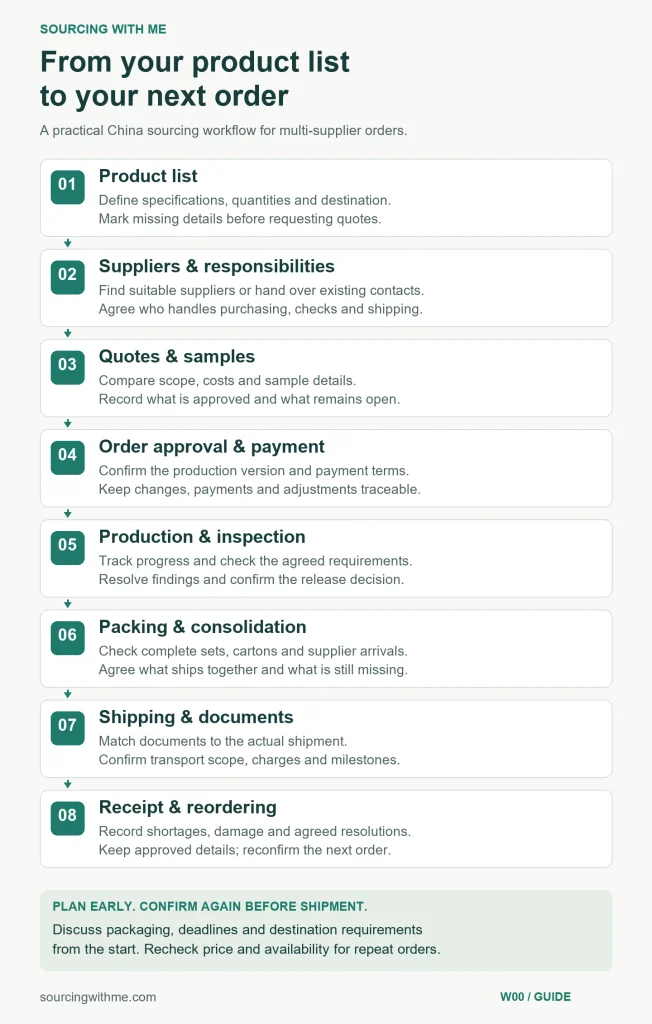
| Stage | What you need to decide or confirm |
|---|---|
| Product list | What you need, how many, and which details are still open |
| Supplier selection | Who can supply the required product and scope of work |
| Quotes and samples | What each price covers and what the samples actually confirm |
| Order approval | The version to produce, payment terms and responsibilities |
| Production and inspection | Progress, changes, defects and outstanding work |
| Packing and consolidation | Complete quantities, protection and readiness across suppliers |
| Shipping and documents | Shipment contents, transport scope and required information |
| Receipt and reordering | Any discrepancies and the specification to use next time |
These stages overlap. Packaging, delivery deadlines and destination requirements should enter the discussion early, even though the final checks happen near shipment.
1. Turn your product list into a usable sourcing brief
You do not need a perfect specification to start. Product photos, links and approximate quantities can begin the conversation. But a supplier needs more detail before a quote can become a reliable basis for an order.
For each item, record the size or model, material, color, quantity per variation, packaging and any customization. Include the destination and when you need the goods available for use or sale. A required arrival date means something different from a factory completion date.
Separate fixed requirements from preferences. If a certain size must fit an existing display, say so. If the color is flexible, make that clear too. Mark missing information as “to confirm” instead of letting someone choose on your behalf.
For a multi-product order, give every item a reference number. That number can follow the item through quotations, sample comments, packing records and shipment documents.
Before moving on: agree which items are ready for quotation and which need further clarification.
2. Decide who will supply the goods and who will coordinate the work
Some buyers need help finding suppliers. Others already have suppliers and need someone in China to coordinate purchasing, checking or consolidation.
In one order we handled, the buyer had already discussed models and prices with a component supplier. The request was to purchase those items and include them in the next parcel. Supplier discovery was not the main task; the handover and purchasing arrangements were.
If you bring an existing supplier, share the current quotation, product details, sample approvals and previous agreements. This helps avoid reopening settled points or assuming that an old offer still applies.
Before work starts, agree who will handle supplier payments, sample review, inspection, collection and freight arrangements. Confirm the service scope and charges, including any visits or specialist checks that need a separate arrangement.
Before moving on: make sure each supplier can provide the required product, quantity and work scope, and assign responsibility for the next steps.
3. Compare the complete offer, then check the right samples
A lower unit price is useful only when you understand what it buys. Compare material, dimensions, finish, quantity, packaging, production time and payment terms. Keep sample costs, customization costs, domestic delivery and other charges visible. Label any cost that remains unconfirmed.
Samples also need a clear purpose. A sample might demonstrate a fabric’s feel without confirming the final stitching or color. Approving it without recording that distinction can create confusion when production begins.
In one sampling discussion, different samples showed different qualities: feel, whiteness and workmanship. The buyer later sent a physical reference sample to China. The useful question was which requirements each sample confirmed, and what the final product still needed to combine.
Record approvals against specific details. Where necessary, request a revised sample or further evidence before authorizing production. For regulated or technically demanding products, identify the required testing and documentation early and confirm the requirements with the appropriate specialist.
Before moving on: know what you are approving, what remains unresolved and whether that uncertainty is acceptable before committing further money.
4. Confirm the production version and payment arrangements
Before a bulk order proceeds, bring the agreed details into one current order record. It should identify the product specification, quantities by variation, approved references, packaging, price, payment terms and the agreed production schedule.
If something changes after approval, record the change and its effect on cost or timing. A short “yes” in a long chat should not have to carry several different approvals.
Payment records need the same clarity. Confirm the currency, payment recipient, amount due, any agreed treatment of transfer charges and which order the payment covers. In our order correspondence, even small differences between the amount sent and the amount received needed follow-up and agreement.
For several suppliers, keep a running record of amounts due, payments received or made, and adjustments. Do not leave a credit from one order or an extra freight charge buried in a separate conversation.
Before moving on: the buyer and the parties handling the order should be working from the same approved version and payment record.
5. Follow production by item and keep inspection issues open until resolved
A general update such as “almost ready” tells you little about an order with several products. Ask what has been completed, what is still outstanding, and the current expected completion date for each item.
Inspection also needs agreed priorities. Give the person checking the goods the approved specifications, reference samples where available, and the details that matter most to your business. Confirm what the inspection will cover and how findings will be reported.
During one factory check, feedback identified lock problems and scratches, and the factory began repairs. Starting repairs was a separate status from completing them. The next step was to establish what had been corrected and what still required checking.
Use that distinction in your own order records: issue found, action agreed, correction reported, correction checked. Where a defect or variation remains, the buyer needs enough information to decide whether to accept it, request further work or discuss another resolution.
Before moving on: review outstanding issues and confirm the release decision with the responsible parties.
6. Check packing and consolidation across the whole order
“Finished at the factory” does not necessarily mean “ready to ship.” Goods may still need inspection, packing, release, domestic transport or warehouse receiving checks.
Track each supplier separately. Record expected and received quantities, carton details, outstanding work and the planned collection or delivery date. Packing requirements should reflect the product and transport arrangements, including protection for fragile parts and labels needed to identify mixed goods.
For product sets, check quantities by complete set as well as by individual component. Boxes, cards, stickers and the main product may come from different suppliers. Having most of the parts does not mean every set is ready.
In one order, 70 cards were missing. The buyer agreed to send the available sets first and include the remaining sets with a later gift-box shipment. That decision required an explicit split and a record of what remained outstanding.
If one supplier is late, compare waiting with a split shipment using current costs and timing. An earlier collection does not automatically secure an earlier departure.
Before moving on: confirm exactly what is ready, what will travel together and what remains for a later shipment.
7. Match shipping arrangements and documents to the actual shipment
When comparing freight options, use the same cargo information and delivery scope. Confirm the shipment’s dimensions and weight, what the quoted service includes, who pays each charge and which costs remain subject to confirmation.
Review document requirements with the relevant forwarder, carrier or destination adviser. The commercial invoice, packing list and other required information should reflect the goods actually being shipped. A late addition, quantity change or air-and-sea split can require another document check.
Keep transport milestones distinct. Collection, warehouse receipt, departure and delivery are different events. Ask for updates against the relevant milestone so you can plan around the goods’ actual progress.
Before moving on: confirm shipment contents, document details, the agreed transport scope and who will handle follow-up questions.
8. Close the order and retain the details for replenishment
When the goods arrive, compare what you received with the packing and order records. Record shortages, damage or product differences promptly, with photos and item references that help the supplier, warehouse or carrier trace the issue. Keep the proposed resolution and its status in the order file.
For a repeat purchase, retain the approved specification, supplier details, samples or sample references, packaging files and lessons from the previous order. This gives the next enquiry a much clearer starting point.
One buyer asked to reorder gift boxes, checked the previous quantity and confirmed another 500 pieces. That is a straightforward reorder request, but the next step still needs confirmation of current availability, pricing, timing and any changes to the product.
A repeat order should refer to the previous approved version and explicitly list any changes. “Same as last time” is easier to act on when there is a clear record of what last time actually meant.
A short checklist before your next sourcing order
- Is each product identified, with quantities by size, color or model?
- Are uncertain specifications and pending approvals clearly marked?
- Do you understand what each supplier’s price includes?
- Are payment, inspection and shipping responsibilities agreed?
- Can you see which items are ready and which are holding up the shipment?
- Do the packing records and documents match the shipment contents?
- Is there one record of outstanding issues and the version to reorder?
Start with the product list you already have
If you are buying related products from several suppliers, send us your list, photos or links, quantities and destination. Include any existing quotations and tell us where you need help: finding suppliers, coordinating an order already underway, checking goods or bringing shipments together.
We can review the information with you and agree the next steps and scope of support.